Living Life on Your Own Terms, with Michael Tejeda

 Apple Podcasts
 Spotify
 YouTube
 Amazon Music
 PocketCasts
 Podchaser
 TuneIn
 iHeartRadio
 Pandora
 Deezer
 Overcast
 Castbox
 PlayerFM
 Podcast Addict
 RSS Feed
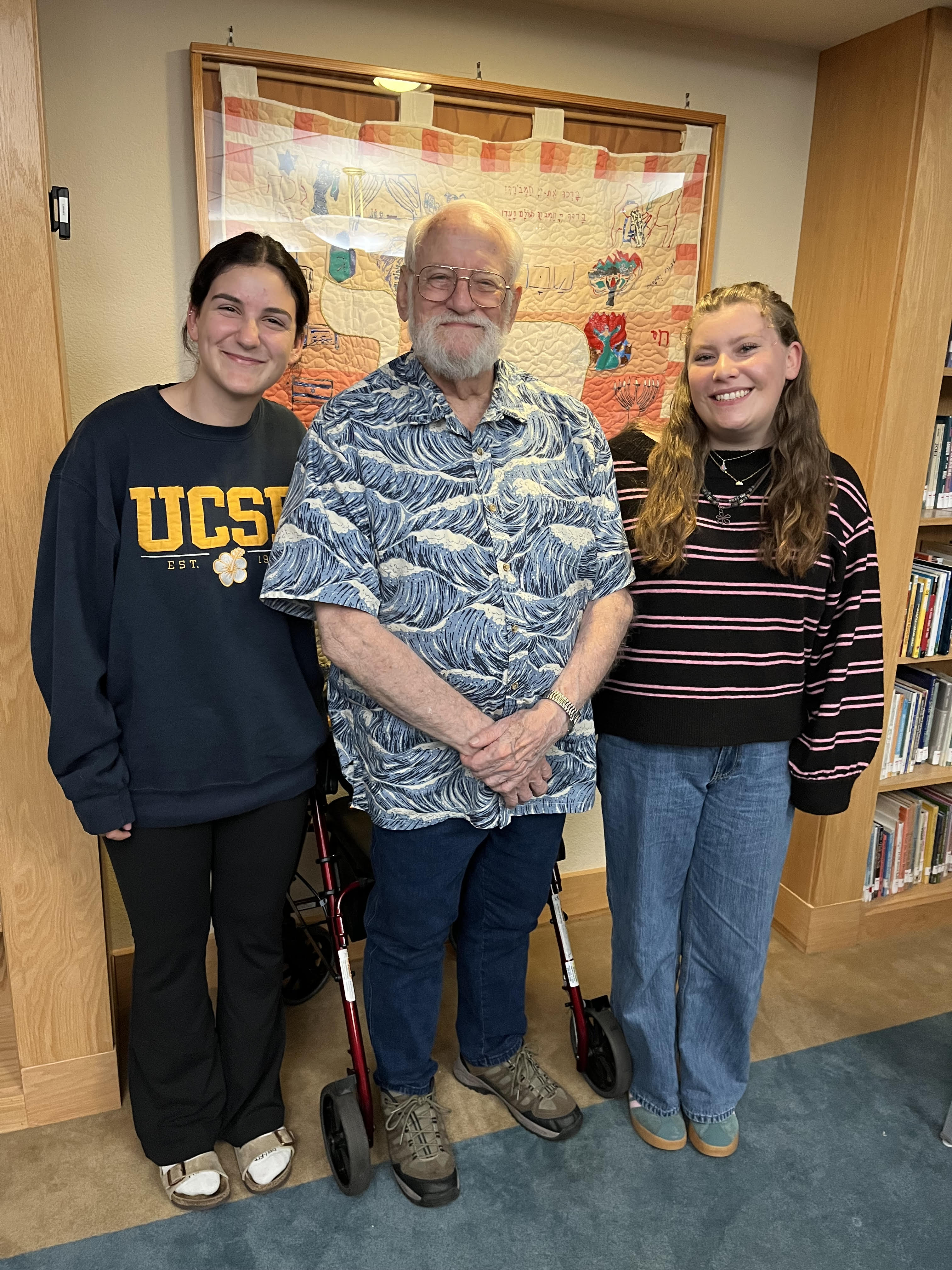
 In this episode of Bina, hosts Aviva Feder and Yarden Crane sit down with Michael Tejeda, an 81-year-old volunteer, book collector, and self-described rebel who converted to Judaism after decades of spiritual exploration. Michael shares how he went from a Catholic upbringing to becoming president of Congregation B'nai Shalom, driven by a love of community and the satisfaction of building something with his own hands.
The conversation ranges from the perils of social media permanence and the freedom of the First Amendment, to the joy of passing knowledge across generations. This includes Michael's plan to surprise a teen in the program with a stack of WWII novels. Whether reflecting on his 3,000-book home library or marveling at teenage energy, Michael offers a simple reminder: old people aren't a separate category. They're just what you're going to be someday.
Thank you to our funders: Sinai & Synapses, Contra Costa Jewish Community Center, an anonymous prominent national foundation, the wider Midrasha community for making this show possible and our brand-new media sponsor, the J. Weekly of Northern California!
If you want to donate so we can make more episodes or have questions for our team, email shalom@binapod.com or visit binapod.com
Michael: [00:00:00] As smart as I think I am and as much as I think I know, even in my old age, I'm better off when I'm talking to other people or trying to figure out what other people are doing, even just like watching YouTube videos or something than I would be if I just sat around and ruminated
Aviva: This is Bina, a Better Together podcast from the students and faculty of Contra Costa Midrasha, where Jewish students, mentors, and elders sit down to share stories and trade wisdom. I'm Aviva Feder. Today I'm co-hosting with fellow Better Together teen Yarden Crane. Today we're talking with Michael Tejeda.
Michael is a beloved member of our Better Together community and a lifelong member and consistent volunteer at Congregation B'nai Shalom. He has printed books, is a prolific reader, and proud to be an avid book collector. We think you'll be inspired to hear his curiosity about life's big questions
Yarden: Michael, let us know a little bit about you.
Michael: Well, I'm, I'm 81. I belong to Congregation B'nai Shalom. I've been an official Jew for [00:01:00] 30 years, but I married my Jewish wife way before that. I have many interests, but I'm very interested in Jews in America, American Jews, however you wanna say it. It's not that I'm... I mean, I'm interested in Israel and all that, and Jews around the world, but I'm very much an American person, and I like to see how Jews interact, how I interact as a Jew, and what I did before I was Jewish, so.
Yarden: Do you wanna explain more about what led you to convert to Judaism? When, what happened?
Michael: Well, I, I was basically a serious Catholic till I was 20, and then all of a sudden I just lost interest. I didn't become an atheist. I didn't become a revolutionary, none of that stuff. I didn't get an Eastern religion.
I just kind of became very neutral about things. And, and, uh, I married my wife when I was in my late 20s. I, I had other girlfriends, and some of them were [00:02:00] Jewish. I knew a lot of Jewish students at UCSB But they weren't religious, so I knew them. So they were ethnically Jewish, but I- they didn't go to shul.
They ate ham, you know, whatever. So I read the history of, of Judaism. I'm, I'm very much a, a historian, amateur, and I would read lots of books. I'd read Jewish novels, uh, Singer and all these people. I'd, I'd read, I read all this stuff in American Jewish authors. But, uh, in terms of religion, I didn't actually think of the practice of it.
But my wife and I, we couldn't have children, so we finally adopted. We lived two doors down from Julia, and, uh, I didn't know her at the time. But, but, uh, we adopted a baby, and then all of a sudden, how do you raise him? So I became very serious about it, even though my wife is very lackadaisical. [00:03:00] She's not, she's not religious.
She was raised ethnically Jewish, not religious at all. And, uh, so I just started taking it more seriously, and in my mind, I think then I was thinking about converting. And it, it turned out that my final conversion was done by Rabbi Freeman at B'nai Shalom. He was also well known. He was the one who bap- who, uh, uh, converted the children, little babies, and, and he had done my daughter.
So I got to know him, and I got more interested in joining a synagogue. And then it became real serious. I mean, I was ended up being the president of my synagogue.
Yarden: I love to hear about just how much you've connected to it and how serious you've gotten. It's so cool to see how you went from one thing to another thing and just-
Michael: Yeah, it was in, uh...
During the middle, I wasn't ver- I wasn't religious. I was-- I believed in God, but I didn't have a practice. So it wasn't that. I wasn't veering among extremes. [00:04:00] The way I do my Jewish life is kind of interesting in that So I, we joined a synagogue, get my daughter in school and stuff, and I realized these are volunteer institutions.
There's no outside support. Synagogues just stand on their own. And so I started volunteering. It was, it's in the bone. I'm kind of a volunteer type. I'm not a do-gooder, but I'm a volunteer. I realized that to build things, people have to do it. So ever since then, I've been a volunteer of my synagogue for almost 30 years.
Like I said, uh, I, I was president. I'm still on committees now. I'm 81, I'm on four committees, so... But that's the way it works. But I don't go to services all the time. I, I do, I do study Torah every Saturday. We sit in a separate room and study Torah in English, but I don't necessarily go into services. I, I attend services maybe six or eight times a year outside of High Holy Days, but every Shabbat I'm studying Torah.
Yarden: [00:05:00] Let's introduce ourselves a little bit. Aviva, do you wanna tell us a little bit about you and who you are?
Aviva: Sure. Yeah, my name is Aviva. I'm a sophomore in high school right now. Some things about me, I am very involved in, like, the Jewish community and also theater. I do a lot of that. It's pretty much a lot of where my time goes.
Yeah, I volunteer a lot. I like to, I like to be in communities and in, a lot, like, in general, communities is such, like, a, an important thing to me, whether it's theater or Judaism, but especially Jewish communities 'cause I feel like it's, it's kind of instant connection for people.
Yarden: My name's Yarden. I am a senior. I can't believe that. But I spend most of my time volunteering. I'm with you of, like, community service, so I do hours after hours, just that's really what I love to do, and I'm planning on majoring in psychology in, um, when I go to college. [00:06:00] So working on that and working on, like, a therapist career, so also doing a little more about volunteering.
So I feel like that means a lot to me. But, um, my Judaism, I feel like- It's gotten stronger over time. At first, I used to go to a Christian private school in elementary, so I was like, didn't always show that I was very Jewish because I just wasn't really exposed to it 'cause everyone else was Christian.
But then as I moved to public schools and stuff, it c- became really important to me, like to show who I am and show like, "I am Jewish and this is who," and represent our culture. So I've worked really hard to make that a part of our school.
Michael: Well, and you, y- you're, because of that experience, uh, of your Christian school, y- you're ahead of a lot of Jewish students, 'cause I'm amazed at how ignorant Jews think they know what Christianity is, and they don't.
Mm-hmm. And so they'll make all these assumptions about how Christians think, and they just really don't know. And, and you at least when you were a child [00:07:00] know what you're being taught and how it is an alternative. It, it's different than what you end up being.
Yarden: Mm-hmm.
Michael: And, and that, that's a very interesting thing.
It gives you a perspective on Judaism that's probably a little, little more fleshed out.
Yarden: Agreed. I think I don't know as much as I, I wish I knew. I feel like I wish I knew a little bit more about different cultures, and I feel like it's so cool of, like, just learning about how different in- people interact and what are their values.
Because a lot of the values are very similar to ours of, like, we value, um, community and being together and helping others, and I feel like that's something you also see in Christianity, which is really cool.
Michael: Well, Christianity started out being Judaism.
Yarden: Exactly.
Michael: Mm-hmm. It's...
Yarden: Right now, well, as you know, we're teens, and I think a big thing of Better Together and the whole reason, like, why we do it is for us to give wisdom to you guys and you guys to give a little bit of wisdom to us.
So [00:08:00] we were wondering if you had a little bit of wisdom for us and a little bit of wisdom for your teenage self. Can you tell us more about who you were as a teenager? What kind of things did you like? What did you experience?
Michael: Well, when you're immersed in it, as you know or you'll know better when you're in your 20s, you'll say, "Oh yeah, that's how I was."
You're just right in the middle of it, and so it is hard to have perspective. And I, I, I think that's one thing good about Better Together i- is, is, is see what other people are like that you don't have to be with. You have to be with your family, but you don't have to be with Better Together. That's a volunteer activity.
And, uh, um, to my teenage self, might have been sort of calm down. Not that it's gonna work out, but you will grow up. You will get taller. I didn't have pimples, or else I'd say that those will go away, [00:09:00] too. You know? Yeah. Uh, i- it's kind of fun to reflect on myself at you guys' age. But there's a, a thing that, uh, that I found, uh, it was the last time we met on Sunday, there was just so much energy in the room.
And I don't know if teens, 'cause you're, you're kind of at an energetic stage of your life, but it was very infectious that day. It was just out there, like an energy in the room. So...
Aviva: I felt that too.
Michael: Yeah, yeah. It, it wasn't the same the next Monday, which happened to be a whole week apart. But on that particular Sunday it was very, very vibrant, and I don't know why I felt that way, but it just, just seemed to be there.
What do you think about talking to old people?
Yarden: Well, I absolutely love it. I spend a lot of time trying to do it, um, in Better Together, but also I'm very fortunate to have my grandparents with me. Um, and so they live, like, not even 10 minutes away from me, so I see them-
Michael: Oh, very cool ...
Yarden: pretty much [00:10:00] every day.
I actually was with my grandma today. But, um, just I feel like I agree with you on the wisdom to, like, teenagers because as, like, a senior to younger grades of, like, take a second. I think I was just telling Aviva this in the car of, like, she's telling me what she's doing and she's like, "Oh, I'm nonstop.
Keep on going, keep on going." Just, like, that mentality of you can't stop breathing until you get into college. Like, I feel like that was something big for me is, like, I can't stop until I get to college. But then you finally, like, take a ti- take time for yourself, take a breath, and understand that it's okay, and you can just have a day for yourself to just be who you wanna be, like, sleep in, do whatever.
Aviva: Yeah. I don't know how much wisdom I have for my teenage self 'cause I think I still I'm freshly here my teenage self. But, um, I'd say people going into high school I think, I, yeah, I do [00:11:00] agree. I think, I think it's important to take time to breathe. Um, unfortunately I can't, but I should. Um, and yeah, I think that talking to senior citizens, like, on a more of a regular basis I think has also taught me a lot about myself and how I wanna show up, and I find myself especially on the Sundays where I see the seniors trying to show up better than, like...
I don't know. I think I feel myself trying to, like, show up more positively consciously. Um, and so I think that's something that I definitely should be taking, like, in my day-to-day life, not only with Better Together.
Michael: The one thing for I, I, you guys all seem to get it 'cause you're very intentionally in Better Together.
But old people aren't a separate category. They're just what you're gonna be in X number of years. Mm-hmm. God help you that you will be make it that long. Hope, I hope you'll [00:12:00] both be 81 someday because the alternative isn't so good. But, uh, but, uh, it's just, it is you as an adult. We all remember our teenage years.
Um, who was it? Who's the lady who's 93 and she kept telling us she was 93?
Yarden: Robin.
Michael: Uh, anyway, she kept talking about it and then you realize she, she remembered the Second World War and stuff and how she felt at that time, and that's when she was in high school, and that was... She's older than me, you know, by 12 years.
So, uh, a- a- and it is just you older. Mm-hmm. And what you realize when you're old is you say, "Oh, that went faster than I thought." You don't think of yourself as in a separate category. You're less able physically, but, like, mentally I'm really, I'm fine. My eyes work, my ears work better. A lot of people are more feeble than I am.
I have a leg problem, but that's not age-related, it's just something wrong with my legs. Um, and [00:13:00] so, uh, but I get the idea that you guys realize that, that it will just be you someday. You'll be as old as your parents, then you'll be as old as your grandparents. And hopefully your great-grandparents, who knows?
'Cause kids your age, there's a lot of stuff that's gonna make you live longer
Yarden: No, I agree. I think that's something that helped I realize with Better Together of like we are the same people. We're all just like, we have very similar commonalities in all of this stuff, and just like we may have years apart, but we're still the same people.
We're, we're still who we are 20 years ago to now.
Michael: I wanted to point out one thing, what you said about being relaxing at home. You kids have pressure that w- we didn't have at that age, and even then, because smartphones and all that, uh, you can be under constant social pressure if you pay attention to it.
When I was your age, you just go home, and [00:14:00] if somebody didn't call you, you were just in your own house with your own stuff, you know, talking to your own family. You could be kind of out of the world if you wanted to be.
Yarden: No, I think technology has definitely had a big impact on who we are, but I also think some things are similar.
Like, I think it's a good thing because it's helped us create so much more information, but it's also has a toxic side.
Michael: Can be overload, yeah.
Yarden: Yeah. How do you feel as a whole, like, about technology? What are the... I know you've seen a lot of like the coming, so now it's AI, but before there were like phones and computers and like how has that made an impact in your life?
Michael: I'll tell you this. I look at myself and I probably would've got hooked into a lot of it. I would've just been right there. I would not have had perspective to step back. The reason that I have it is I wasn't immersed in it at the time, so it evolved way more slowly in my life. 'Cause remember, we already had phones and radios [00:15:00] and TV.
Everything was there. Cars are still cars. Doesn't matter how many buttons they have on them now, they still function the same and speed limit's still the same actually. I think technology, a lot of it is a false promise. I thought things would get a lot better than, and it, but technology also magnifies bad stuff, and that's too bad, at least socially.
But in terms of medicine and stuff, it makes things better. Th- that's for sure. I mean, there are very few bad medical developments. Sometimes people go off on tangents, but it doesn't... If they figure out a better way to heal something or fix you, that's fine with me You know? I mean, I'm 81, you know, so anything they have, I like.
Yarden: Do you wanna go more into, like, the bad side and what... Like, what do you mean? Explain more about that.
Michael: Well, what... It's hard for me because, because I've, I've a sense of myself. I'm not particularly vulnerable. [00:16:00] People could say bad things about me online. I don't care. What do I care? Just don't turn it on. But the idea where you're always communicating with your phone constantly, and, and I'm weird in this one way.
I'm not a Luddite or anything. I mean, I'm on my computer all the time, but I don't care about my phone. My phone is a phone. That's the way I look at it. It's not a communication device. I communicate on my computer. Well, it is a communication device, but just vocally. That, that feedback, I could care less.
And, um, I, I do do one thing, and, and this isn't good. There are things I don't say online, and I'm not saying they're nasty or anything. It's just that it's not... I'm kind of politically incorrect, and so it's not what most people think. So I just... It's not that I'm shy and retiring. I just don't say it. And it's not for fear that somebody's gonna put a negative comment after that.
It's just, like, I'm just... I'm not trying [00:17:00] to make a statement in that regard. So I feel, in a way, it makes me a little less honest. Um, the potential for bad feedback makes me a little less honest. 'Cause up here, I'm still thinking the same thoughts. I, I don't mold myself to popular opinion, so, uh... But I also on the other hand, I don't feel like everybody has to share my opinion, so if I don't say it, that's fine too.
And, uh, what I, what I... It's hard for me to, to grasp is how negative somebody like you could feel if kids were piling onto you on your phone. It's a little hard for me to g- to imagine how bad that would be. I, I can imagine it, but it just so... I, I was... I mean, smartphones only came out, what, 20 years ago.
That's it. You know? And, um, not, not even my, my, my daughter and all her peers just had cell phones for a while before they got smart. They got to grow up without it. [00:18:00] I guess maybe the good thing is if you learn how to put up with it, but it... There are things that can just magnify the bad. What do you think is bad about technology?
Yarden: I, I think I do agree with you. I think there's just such a high standard with social media, I would say, especially in, like, just... It's sad. It's sad. Sometimes I, like, look at myself and I'm like, "I could not go a, a day without a phone." And I try not to, like, go overly on my phone or just, like... But there's so many things nowadays that just, like, like requires you to have one.
I feel like it's, like, that social obligation. Like, even if you wanna try not to, like, you'll need one eventually. I know a friend that I have of... She had a flip phone, and she would, like, she would refuse to get one until she was, like, sophomore, junior year, and she was just required to get one, like, just because there's so much information that's put on there that we need.
But then on the other [00:19:00] hand, like, what you're saying about bullying, like, it makes sense. I know so many people of, like, it's creating a new form of people to spread around hate. It's creating a new form for people to hide behind a mask and basically just say what they want, which can really hurt other people.
Michael: Yeah.
Aviva: I just did a project in school about how people are more inclined to be more unkind when it's, um, anonymous, and that got me thinking a lot about social media and how it's so much easier when you're just someone typing instead of talking to them directly. And so I think that's definitely a negative effect, especially about social media, because it is pretty necessary.
Like, I was required to get Instagram for, um, a volunteer position I had to, like, work the social media for it. And part of me wishes that we could just, like, send an email out or something, because it does definitely subject to, like, hate, and it's just so much easier to be a bad person [00:20:00] when you're not held directly accountable for your actions.
Michael: Yeah. See, when I was a teenager, and this is true not just in my generation, but for a lot of, lot of people, like you could, you could be kinda stupid, and you could say dumb things to your friends or be awkward, but it didn't spread all around the world. It didn't go under your permanent record, and you get to grow up.
You could say something hateful or stupid once and never say it again. But if it, if it gets into your phone or whatever, that becomes something you're identified with, you know? And that, that's kinda hard, uh, that, that you don't get to just be a, a dumb kid, you know? Because everybody goes through that, and why, why should it be in your permanent record, so to speak?
Yarden: Oh, I think that's a really cool way to look at it. Like, it's sad though because let's say that someone made a mistake as a teen and, and then they grow up, and then they still have that, [00:21:00] like one thing, that one thing that they posted that maybe they were in the wrong head space, like they shouldn't have done that, and then they finally realize and become a better person, but they're still associated with that bad thing.
And I think that something that, like I fear... I'm president of Jewish Student Union at our school, and she's vice president, and so we have an Instagram. And so I always like, sometimes when we post or something, 'cause we'll always post for like announcements and whatever, um, I'm always a little worried about like what are the negative comments that people are gonna put on or what is, what's gonna create that lasting effect that may not be positive to our club, I guess.
Aviva: Yeah, I think there's always a little bit of hesitation when we post, especially on the JSU. What do you guys think about like the permanence of, you know, online and social media? Do you think there's any like positives to it?
Michael: Well, makes it easier to [00:22:00] catch bad people, but it depends on who's gonna judge them.
If they, if society isn't gonna judge them, then they just be bad people. Mm-hmm. But, uh, I, uh, it, it's... Yeah, uh, the permanence, it can last way too long. It, it, becau- it, it's easier before this, and before- It, it not... It's just nor- not smartphones. It, it's computers to a certain extent. But, uh, you should be able to outlive, uh, say, a bad reputation or a mistake, and it's much harder with this, and, and I don't, uh, I don't like that, I'd say.
'Cause, you know, this is gonna sound a little overly philosophical, but America has this kind of culture of redemption where you can make a mistake and then do something else. Well, you're always identified with the mistake. Well, is that good? And it, it go- it [00:23:00] goes against the, the grain, which isn't just Jewish.
It's just kind of American, th- this, this idea we have in society, which is actually a pretty good idea.
Yarden: I like that. I also feel like it ties into the Jewish values of, like, would you say that that's something that's really important to you of, like, forgiveness and just starting a new page, I would say?
Michael: Well, yes, and I'm not one of these people who goes around forgiving murderers and stuff. I'm not like that, and I don't think Jews have to be either. They're not Christians. That's a, that is a difference between Jews and Christians, where you're kind of required to forgive. I think it's good if you, if you can get past the mistake you made, like even criminals.
I've actually... I had, I've had businesses for years. I was self-employed, and I'd, I would hire felons who had maybe done one thing in their life, but they weren't real bad guys. But you have to weed out guys who really are bad, you know? And, uh, and then you give them a chance, and if they didn't commit a crime that w- had anything to do [00:24:00] with what your business is, you just hire them, and if they do a good job, fine.
That's it, and that's a kind... That's... That isn't, that isn't general forgiveness, but it's, it's a second chance. You know, the guy really was a felon, but I really did hire him after he was a felon, you know? And, and that's, that's good. I don't, I don't think just forgiveness is the issue. I just think it's a second chance.
You don't have to say, "You're blameless. I'm... That I now forgive you." Like Catholics, they absolve people of sin. It isn't like that. It's, it's you're just giving him another chance. You've grown up a little. Okay, fine. You know?
Aviva: I think it's acceptance rather than, like, blatant forgiveness.
Michael: Yeah, yeah, yeah, and acceptance is fine 'cause we're all, we're all human.
We all do stupid things and make mistakes and stumble. You know, stumble a lot when you're old.
Yarden: Physically and
Michael: Yeah, yeah
Yarden: Can you talk more about, I'm really [00:25:00] interested about, like, what jobs did you have and what did you hire them to do? I was more-
Michael: Oh, I was, uh, for about 20 years I printed books. You know, these things that people don't read anymore. Uh, I literally, I printed books, but books that were short run, so they were like college syllabi and stuff like that, where you'd, where a professor would make like an instant book.
They'd say they'd have a bunch of articles, they'd put 'em together and they have 100 or 200 students, and that's all. There are no more books than that. So I would do these very short runs. I would also do, uh, novels, poetry books, things like that. So printers are, is something that people, young men who are criminals, but they're on good behavior.
They're not criminals in an absolute sense. They did a crime. Especially in federal, uh, um, prison, one of the things they teach you is printing. And so I hi- I'd hire these [00:26:00] guys 'cause they use the same kind of presses. They were these small presses that we'd use. And, and as long as they could do that, you know, and whatever crime they did didn't involve stealing from their boss, you know, it was something completely different, I would, I would hire them.
That would be the main thing. I was in situations like that where I had employees that I couldn't hire or couldn't keep on. That's all. Uh, it's very male-oriented. Um, none of the women I ever hired had, had records.
Yarden: Interesting. Is there a reason, like, why you got-
Michael: Well, m- men, men commit more crimes than women.
It's real simple. At, at whatever class, it's always men do something like 90% of the crime. It's quite, quite high. Nobody ever talks about equal representation here. Well,
Yarden: I think some women can be stupid too.
Michael: Oh, no, no, it's true. It's true. Some
Yarden: different things too.
Michael: Yeah, it, it, it's... No, it's true, and, uh, it, it's...
But just the women were just weren't out that way. I wouldn't think women just aren't nearly as violent as men. [00:27:00] Verbally they might be, but physically they aren't.
Yarden: That's what I was
Michael: thinking. And we have free speech, so you can be verbally violent.
Yarden: I think that's something, like social media too, is like- Yes, yes
verbally violent, like that's definitely... Do you think-
Michael: Well, you know, on that free spee- on that thing about social media, you know, there are countries that we think of as free countries, like England, if you send a text to somebody that's insulting or any number of things, you can actually go to jail.
Aviva: Huh.
Michael: To an American you'd say, "What? How, how can this be?" And that's people who are approximately equivalent to us in terms of class and money and education, and yet in their society you're not allowed to do that.
Yarden: But I think we still have some censorship of like, well, you work with printing, but like banning books, and there's still a lot of books that are being banned and have-
Michael: By who?
Yarden: By-
Michael: [00:28:00] Private institutions? You don't have... There's no book you have to have in here. Mm. You can throw out a book if you don't like it. Is that censorship? Well, sort of, but it isn't overall. I mean, I, I know this. I printed books. It is literally protected by the First Amendment. People would come to me and say, "Can I print this?"
And I said, "Of course you can." And nobody comes around to look at what you're printing. So, and now whether, uh, people buy it, that's something else. But, but in the United States, that tends to be private. And you can say it's a form of censorship, and yes, it is. Like YouTube was censoring people for a long time, even Google.
You would th- have things you couldn't search for, but now you can. So did censorship end, or did they just change their standards, or did they just open a door? But compared to other places, we're very-- we're more open than you think. E- even though you may be worried, we're just way more open than most, most-- than probably any country, [00:29:00] uh, really.
I study this a lot, and I'm just amazed how people talk about it. But then the real fact is, uh, you know, you're not really prevented from doing this. Sometimes you think people should be, but you know?
Yarden: Do you think people should be prevented for, like, what they would-
Michael: From saying things?
Yarden: Yeah, from saying-
Michael: No, I believe in the First Amendment.
I, I think we wouldn't have had America without the First Amendment. They were revolutionaries, you know, and they could say what they wanted. Overthrow the king, which was a much bigger deal than insulting your neighbor, you know?
Yarden: I guess my other question is then, going back to our teenage self of, like, would you consider yourself more of a rebel as, during your teenage?
And remember, you were just talking about riots, and so can you talk-
Michael: Yeah, yeah. No, I was a rebel. No, in the riots, I was a little older. I was, uh, in my 20s, and I was a reporter, so I would just walk through the riots. I'd be there when they were breaking things and breaking windows and burning cars and stuff.[00:30:00]
But I'd, I'd look like now, except my hair was down to here, so nobody, "Oh, okay, you're all right," you know? And, and I wore this kind of old Army jacket, and they didn't know, but I wasn't doing any of the stuff. But yeah, I was always a rebel. It's interesting that you would ask that question, because as an adult, I've always said I would prefer to be the most liberal guy in a very conservative society.
So I would just hang around the fringes and do what I wanted, but society would run orderly. I'd go out on the street, and people obey the speed limit, you know? 'Cause I don't wanna live in chaos, but I wanna be able to do what I wanna do. And how it manifested in my life was that I have been, uh, self-employed since 1973.
I didn't have a boss. My boss were my customers. Uh, uh, but I didn't have a boss in any kind of hierarchical structure. And my wife and I were in business together, and we had a third person for much [00:31:00] of, for running the printing business. And our main thing in common, they probably weren't as entrepreneurial as I was, but they didn't like to be told what to do, and I didn't either.
But that still doesn't mean you're not told what to do, just you tell yourself, and you can be a very hard taskmaster on yourself. So it's not that I was doing anything. I wasn't out there partying or something. I was actually working hard, but had no boss. Ev- everything I made was on my own And I was not successful when I worked for other people.
So that, I guess you could say that's rebellious. I was participating in the society. It's like my volunteer work at the synagogue. It's all volunteer work. Nobody tells me what to do. What I hated was being president when everybody tried to tell you what to do. I literally hated it for two years. Being a president of a synagogue is a terrible job.
But all the other stuff was neat, you know, building sukkahs and being on membership committees and doing newsletters. That's, that's all interesting stuff, and you can just pick [00:32:00] what you want. And, and the job tells you what to do, 'cause really nobody's your boss in, you know, i- if you're a volunteer at a synagogue.
Synagogues are not particularly hierarchical. There are people who think they know what they're doing and are smarter than you. I mean, a bunch of Jews, you think everybody's gonna say they're smarter than you? Yeah, of course. But, uh, it's not like the employees of the synagogue who do work for somebody. I mean, the rabbi has a boss, the board.
That's my thought. A, a very independent thinker.
Yarden: No, I really like it. I like the way... I think it just shines a new light and it, I think that's another reason of why I love Better Together so much is just you get to see those new perspective, is like if you don't talk to other people, then you're never gonna learn about new things.
And so talking to other people and talking to you just, like, gets my gears turning and just, like, gets me to think about, like, what do I wanna do? And especially as I'm going off [00:33:00] into college next year of like, like what do I want to define?
Michael: And what have you not thought of yet that you might think of then?
Uh, uh, uh, an interesting thing is, um, i- is, is that very thing that you, you don't know what you don't know. Unknown unknowns they call it. And, uh, uh, and just by hearing what other people do Uh, you know, 'cause some people, I've, I've, I've listened, overheard other adults that were just in a career their whole lives, you know?
You know, if you end up going into psychology, which you have plenty of time to change your mind, and you, you end up in private practice, yes, there will be standards, but you'll be your own boss. You'll plunge the toilet, you'll pay your rent, you know, you'll do all the things because nobody's gonna support you, unless you work at an institution and, and other people tell you what to do.
Mm-hmm. You make a choice.
Yarden: Interesting. [00:34:00] Okay. Aviva has a question.
Aviva: What do you think caused your, like, want for independence and, like, you wanting to be your own boss and this kind of stuff? Were there any, like, influences on that or anything?
Michael: You know, I don't know. I think- I, I didn't have any singular event that made me that way, so I just think some people turn out that way.
And like I said, I can be a real cooperator. It's not that I'm so ornery, it's just that I just don't like people telling me what to do. But I didn't have confidence when I was younger, and so I didn't realize that, so I kept thinking, "Well, I'll just get a different kind of job." Or in the end... And th-this is funny.
Uh, this, this goes back to your thing about n- uh, not knowing what other people know unless you ask them. As b- as smart as I think I am and as much as I think I know, even in my old age, I'm better off when I'm talking to other people or trying to figure out what other people are doing, even it's like watching YouTube videos or something, than I would be if I just sat around and [00:35:00] ruminated.
Now, some people are like that. They can just sit around and come up with things. I, I don't. I, I, I, uh, I need other people, uh, if only to find out what I don't like. But with, with Better Together, there's very few things I don't like 'cause we're just relating to each other, and there's... It's not a thing of you giving me direction or me giving you direction.
It's what are you doing, what am I doing? It's more like that. And you can have things, like my book printing business. You could think that's the coolest thing in the world, but it's not a good business to go into now because books don't sell that well or anything. And yet, when I was there, I mean, there, there had never been more books published in history than, than there were in the 1970s and '80s in America.
Just books galore. People... Books nobody read. Going to Barnes & Noble at the time, a full Barnes & Noble, and just books on esoteric subjects, and then that really fell off quickly between computers, Kindles, and I... And, and [00:36:00] people just not reading very much. And now I'm not sure if you'd give books away free if you could get people to read them, 'cause people's minds, uh, younger people, because people my age still read like crazy.
That's, that's who buys the books. There's still millions of books sold, but not hundreds of millions.
Yarden: Do you still read like crazy?
Michael: Yeah.
Yarden: What's
Michael: your favorite- I have about 3,000 books in my house, and I've given away about 1,000 in the last few years. And, and y- and I'm... It's not... They're, they're not, uh... Well, okay, like that shelf there, a lot of har- paperbacks.
My, my books looks like that. They're not a bunch of nice embossed leather-bound or something.
Aviva: I think 3,000, that could probably legally be classified as a library, I think.
Michael: Oh, yeah. Well, I knew a guy at my synagogue who died about a year and a half ago, Bill Gottfried, and he was a doctor, you know. He wasn't a book man.
He had 33,000 books. Yeah. Yeah. I don't know what his wife, poor woman, did with them, but apparently my, [00:37:00] my wife was at their house once, and they had just books everywhere, and they had these reinforced steel shelves, basement, attic, where... Books everywhere, and 'cause he was very into, uh- Uh, mystery, uh, books.
Even though he was a doctor, right? But his avocation was mystery genre books, especially mystery books. So he had ... People would send him books for free. Publishers would just send him every edition of something. So, uh, before he died, he had 33,000 books. When I met him, he had about 25,000, so he got about 8,000 during the time I knew him.
So I was just a piker compared to him.
Aviva: That's crazy. You mentioned giving away books. Can you talk more about that?
Michael: Yeah. I tr- I try to give them away. I just don't, uh ... I'm trying to get rid of them, but I don't like to give them to the library because I- i- it's a good way to recycle books, but a lot of times they'll just...
It'll just be in a, a bin, you know, for 25 cents, and [00:38:00] if they don't sell it in a month, they, they actually dump them. They give them to Salvation Army, and then, and then if they don't sell them, they just dump them. Whereas, if somebody was interested in a particular topic, you know, I might have eight books on that topic.
I d- I have this, this, uh, about 12 books about dogs and raising dogs, and I just put them, uh, in a different shelf 'cause I was making room for something else. Well, if I gave them to the library, maybe somebody'd be interested, maybe not, but if somebody's real interested in dogs, I give them a library of dog books.
Here's an example. About... When was it? It was the last Sunday that we were together, I was talking to, um... Do you know who Sydney is? Okay. I was talking to her, and just out of the blue, we were kind of in this structured conversation that Julia likes us to be in, and then we just started talking about what are we interested in, in reading.
Something came up about reading, and she said she liked books about World War [00:39:00] II, and sh- and just, and she had just finished a book called, uh, well, I can't remember the name of it right now, but, but I had also read it. And I thought, "Wow," and I, sorry to say it this way, "but this kid is interested in something that I just read and six guys in their 80s just discussed six months ago."
All the Light We Cannot See, it actually was turned into a movie. Uh, it was written a few years ago, but it was made into a movie kinda recently. I didn't see the movie. But it was about World War II, and I thought, "I didn't expect anybody of y- of your age group to say, 'I'm interested in reading about World War II.'"
So I, I knew I have several books. I have a whole bunch on the military part of World War II, a bunch, like 50 or 100. But I, I have some novels written during the time that were about families and about... And not about the Holocaust part, but about Americans, uh, about people in the United States or people in Asia who were caught [00:40:00] up in the war, but they weren't soldiers.
And so they're family stories. They're not all pleasant, but they're not real depressing either. They're just stories, like All the Light We Cannot See, which is a historical novel. Uh, and, and so I thought I would, uh... I, I picked out two books and I'm gonna... She doesn't know this, but I'm gonna ask her if she wants them.
I'll bring them to her, uh, well, I guess next time we meet on Sunday. She's gonna be there, and I'll see if she wants them, these, these two particular books, and I'll lend them to her, but she could also just keep them if she wants and pass them on to somebody else, and I hope she's interested. But I... It's, it's, it's a thing- I know a lot that I wish I could pass on, but it's not the standard that you'd learn in a classroom from a t- particular teacher.
Plus, I'm way past retirement age if I had been a teacher. But I keep learning all the time. Although these books I did read a few years ago, so when I was younger. [00:41:00] But, so just things like that. And if somebody was interested in... Well, there's a variety of things. I could lend them books on or just give them books, you know.
I have a nephew who's, who's very interested in, uh, old science fiction, so I gave him a bunch of books and, uh, stuff he would never think of picking up himself now, because science, science fiction now is fantasy and magic and stuff, and this is old rocket ship type stuff, you know? When people hadn't gone to the moon yet.
Mm-hmm. I've been reading science fiction since before people went to the moon, so...
Yarden: I have, like, two follow-up questions and just so much to process. But, um, I've had, um, a similar experience to you of one of our senior citizens in the program, Michelle, I don't know, she hasn't been for the past few weeks, but she actually gave me...
She stopped printing... She's a writer. Um, and so she stopped printing her children's book. She wrote, like, six children's books or something.
Michael: Oh, boy.
Yarden: But she sent me one of her children's books that she [00:42:00] discontinued, and so now I have that. And I, like, the same thing of, like, passing it down so now I can read it and then read it to my children, and just, like, the same thing with you and Cindy of, like, now she can read it and-
Michael: Yeah, if she's interested.
Yeah.
Yarden: Yeah, of course. But, like, I love this, uh, the Jewish ideal of la dor vador of, like- Yes ... passing it down from- From generation ... generation to generation of, like, just these experiences and these cool things. But, and then my second, my actual question I guess is, what's your favorite genre? Because... And your favorite book.
Michael: Oh, so many. I, uh, I read a lot of nonfiction.
Yarden: Okay.
Michael: But in my book group, several of the guys who happen to have been doctors in their careers, there was a time in the '60s when medical schools were recruiting from liberal arts majors. So these guys were English majors who became doctors. They weren't... You get the other guys who became doctors 'cause they studied every minute of their life from [00:43:00] fifth grade on, and those are a different kind of mentality.
But these English major doctors, they actually have broader minds, and in their old age, they're interested in fiction, not, not in nonfiction, because they lived their life doing medicine, you know? So, uh, I like... Oh, it's a little hard to say. Y- y- you, you could go in and out. It's like, say, what are your favorite kind of movies?
Well You know, today it might be a Western, but tomorrow it might be a docudrama, and the day after that it might just be a rom-com. You know, and, and, and you can like them all and s- and want to watch more of that genre. I'm a little like that with books. Uh, it's not everywhere. Like I don't... Um, to go to sleep I read mystery stories.
Otherwise, I never read them. My wife reads mystery stories all the time. All the time. And she's really smart. She went to Harvard and she went to Berkeley, but she reads mystery stories, and I'm reading [00:44:00] all this thought-producing stuff. Plus, I read a lot of magazine-type articles. I, I print them offline a lot of times, but it really is the same as picking up a magazine and seeing an article.
Well, I just see it online, and I can't stand to read on the screen, so I have this... Maybe it's eccentric, I don't know. I print them out. I put them in 14-point type and print them out. So I'll just read them and, and there are... I, I read Jewish stuff, a lot of American politics, but not specifically about individual candidates.
But I'm, I'm very... As I've gotten older... When I was in high school, I wasn't very interested in American history. I thought it was boring. And, and it's funny because I knew it was the story of us, but I just wasn't very interested in it. I thought, "Oh, Europe is so interesting," or whatever. Well, as I've gotten older, I'm very interested, and very interested also in Jews in America and how they've been part of the American story.
And, uh, uh, [00:45:00] so as I, I get older that I read that stuff. Uh, you can say it's history or just Tangentially history, you know. And I, I keep up with current events, but that's more a podcast thing
Yarden: Podcasts. Perfect. See, we are... Can you tell us more about what, what... I know there probably wasn't, like, a specific moment, but, like, what made you kind of switch from just wanting to know about American history and, like, what, what sparked that curiosity?
Michael: When I was a kid, we didn't have TV even though we were middle class. We were in the military. We just lived in places where there wasn't TV. So when we came back to the States, all the kids had TV. I didn't have it. My mom had made me very conscious. She'd always get me books, uh, like Davy Crockett or teach me songs of the pioneers sang Shenandoah, you know, all these various things.
So I just thought it was part of the story. I [00:46:00] didn't pursue it as an interest. But, um, as I got older, I just got interested. Well, you're in a place, so what happened here? And, and it, uh, uh, all of my adult life, it's been accreting and, and sometimes you just go back and read a book about it, and other times you find out from some local telling you.
Like I go to, as I've traveled, I go to little towns and see their little local museum, and you realize something important may have happened there. Like, I was in Sonora in gold country a week and a half ago, and I think it's real interesting up there. I haven't been to the Jewish graveyard yet, but a lot of kids go there.
They're Columbia in, or in, uh, what is it, in fifth grade I think, and you see the gold panning and stuff. Well, it's California history, and it's everybody's history. I mean, there were Jews there. There are Jewish graveyards right, right ne- right near there that are now coming back to prominence. Jews from the Bay Area have gone up and cleaned them up, got rid of all the weeds and stuff, and now [00:47:00] there's small Jewish communities up there.
So you say right from, in California terms anyway, their, their first high holy days services were in 1850. Well, that's just right after the Anglos arrived. They arrived in 1849, so it was right there. So things like that inspire me, uh, and it's not- It, it's like a story, only it's true
Yarden: This last year, um, my junior year, I was required to take a California history class, and so just learning about it and there's so many things.
I didn't grow up in California. I actually lived in Texas and I moved here, um-
Michael: They really teach you history
Yarden: in Texas, don't they? Just... Oh, yes, they do. Yeah, yeah. But five years ago I moved here, and so just learning about, um, how people migrated to California and, like, what happened from the start to when whites came to just, like, learning about things that I never would have known before.
Just-
Michael: Yeah ...
Yarden: I'm with you.
Michael: Well, and, and as you get older, what's happened to me is I had to... [00:48:00] When I was, uh, young, in seventh grade, that's when you did California history. Everybody- I went to a private school, but everybody did it the same year. And, um, it's not that you weren't taught correctly, it just... you were just taught part of the story.
So as you get older, you know, you can flesh that story out. And I never thought of all the ethnic groups. That was an adult thing. I realized, oh, San Francisco's weird. Old money is Irish, Italian, Jewish. It isn't WASP. And, and I mean, it became WASP, but it, it wasn't originally, unlike the East, you know? So it was very different in California right from the start.
Uh, so a, a lot of these names you see, you go, "Well, what's unique about that?" They didn't name streets after Irishmen in 1849 back East. They did here, you know? 'Cause nobody was prejudiced against the Irishmen. They, "Oh, you came just like me? Okay, fine You know, you don't read about, uh, [00:49:00] uh, Levi Strauss. Like, maybe he had problems elsewhere, but you don't read about any anti-Jewish problem in California.
You just read about how he had to figure out how to make pants, you know? And, uh, and so it's taught. It's, it's, it has an ethnic dimension, but it also just has a people dimension to it.
Yarden: I like that. I feel like that's a really good view of, like-
Michael: Yeah. 'Cause that, that's one thing, and I'm, I was n- not raised in this ethnic consciousness baloney that, that, uh, i- it has been inflicted on people much younger than me.
So it was all... I happened to go to Catholic school when I was a kid, but there, it was multiethnic and almost everybody was a f- a stranger, i- including the Mexican kids. Everybody had moved here. So you're just taught as, not anonymous, but they never emphasized ethnicity, just you're all [00:50:00] Catholics together, and actually 95% of what you take is just secular courses.
And, and so that ethnic thing never... I, I, I wasn't very conscious of ethnicity. I'm a little bit because my last name is Spanish, so everybody asks me. So the, my, my thing is, is, "What's your last name?" "Tejeda." "What is that?" "It's Mexican." "Funny, you don't look Mexican." That's, that's all my life. My whole life that's been that, so it's a weird form of...
I- now, if I were overly conscious or, or, or, uh, overly sensitive, I might say that's racist, but it never occurred to me, so.
Yarden: Interesting. I think a lot of the work that I do is ethnic. I think that's funny of, like, you had this shift when you were older, and I've had this shift, like, I guess when I moved, but now I do, I plan events, and I plan, um, months based on ethnic cultures within our school.
And, and so that's basically what I [00:51:00] lead and do, um, within our school of just, like, we're having, for Black History Month, we're having a museum. We're just, um... For Holocaust remembrance, we bring, um, Hana. She told her story last year of just, like- Right,
Michael: Hannah, yeah.
Yarden: But just, it's, it's funny to see that we have such similar connections of, like, that interest, but just you may have found it a little bit later, and it's something that's also very important to me now, so.
Aviva: Thank you so much for coming in and talking to us today. We had so much fun, and I really enjoyed learning from you and hearing all your stories.
Michael: It was a pleasure.
Yarden: Thank you so much
Aviva: Thank you for listening
Yarden: to Binah from Contra Costa Midrash. I'm your host and lead producer, Yarden Crane. Our senior producer and editor is Andrew Sims. Our associate producer is Aviva Fetter. Our producer is Julia Kurzrock. And our executive producers are Devra Aarons, [00:52:00] Aron Korney, Shahnti Brooke, and Rob Goldman.
We also wanna thank our funders, Sinai and Synapses, Contra Costa Jewish Community Center, an anonymous prominent national foundation, and the wider Midrash community for making this show possible. If you want to donate so we can make more episodes or have questions for our team, email shalom@binahpod.com or visit binahpod.com.
Our Binah Better Together podcast presents candid interviews and personal stories, including memories, opinions, reflections, and personal information. These conversations are shared from each speaker's perspective. Whenever we edit for length and clarity, good faith efforts are made to reserve the accuracy and intent of expressed statements.
All subjective views and opinions expressed on air are those of the individual speakers and do not necessarily reflect those of Contra Costa Midrasha, Human Content, the student host, the production team, [00:53:00] or any affiliated individuals and organizations. To learn more about our ethics policy, visit binapod.com.
This has been a Human Content and Contra Costa Midrasha production.


